Showing posts with label Dubai. Show all posts

Saturday, 1 December 2012

New UAE labour law changes from January 2011


New UAE labour law changes from January 2011

Retirement age in UAE

Maximum age that foreign workers can be employed in UAE increased from 60 to 65 years old.

Part time work permits for students and other expat residents

From January 2011, university and college students sponsored by the institute in the UAE at which they are enrolled can legally work part-time under certain conditions. Students need to apply for a part-time work permit from the UAE Ministry of Labour (MOL). Not clear if students must be studying full-time, or if the new labour law decree also applies to part-time students.
A report in Gulf News 08 February 2010 said Gobash recalled an incident when the son of General Shaikh Mohammad Bin Zayed Al Nahyan, Crown Prince of Abu Dhabi and Deputy Supreme Commander of the UAE Armed Forces, was denied the right to take up a part-time job in a company because there was no law regulationg [sic] these work permits. Implying that UAE National students also need a part-time work permit to be legally employed.
The part-time employment permit is also available to expat residents working full-time who have a valid labour card, and to expat wives sponsored by their husband. Not clear if expat husbands under wife sponsorship can also obtain a part-time work permit.
The part-time employment permit allows the holder to be employed in more than one part-time job.

Juvenile or teenage work permits

From January 2011, teenagers from 15-18 years of age can find jobs in the UAE after obtaining a teenage work permit from the MOL.
There are restrictions on the type of work and hours of employment. Ministerial decree 1189 for 2010 specifies 31 categories of work in which juveniles are not permitted to work, including underground jobs in mines, quarries, and other work related to mining; furnaces of melting metals; oil refining; bakeries; asphalt industry.
Some reports refer to the work permit as part-time only but it appears that full-time work is permitted.
Validity period of juvenile work permit is one year maximum.

Short term and temporary labour permit in UAE

Expat and foreign workers over the age of 18 (and less than 65 years of age) who have not previously worked in the UAE can now apply for short-term work permits valid for 60 days at a time according to UAE Ministry of Labour (MOL) information reported by the Al Khaleej newspaper 26 January 2011.
The 60-day work permits can be renewed up to 5 times (6 times reported but later information said maximum total period of one year), renewal must be made before expiry date of the permit or last renewed period.
Work permit initial fee AED 500. Work permit renewal fees and bank guarantee amount not reported.
Fine of AED 500 will apply for every 10 day period past the expiry date.
Permit will automatically be cancelled if fees and bank guarantee not paid within 60 days. Not clear if this means within the validity period, or within 60 days after expiry of the permit.
Short term work permits not available to UAE and GCC nationals (not that they need a work permit anyway, at least not UAE citizens).
A report in Emirates Business 24-7 on 05 February 2011 said "Also, priority will be given to Emiratis and GCC nationals who can take up the required job" making it sound like those nationalities need to apply for a short term permit, however it is more likely that the intention is that permits should only be issued to foreigners if the company cannot find an Emirati or GCC citizen to do the same job, since they don't need work permits for the UAE as far as we know.
Applications to be made at Tasheel center by employer or company representative, who must have electronic signature authority. Workers cannot apply for a temporary permit themselves.
In some circumstances, e.g. unpaid salaries for more than 2 months, workers can obtain a temporary work permit even if their current employer objects

Changes to laws about part-time work in the UAE - January 2011

Students and housewives can work part-time in the UAE according to changes in the UAE Labour Law from January 2011.
Part-time work permits will be available for one year at a time (fee AED 500), but female dependents and students with UAE residence visas will not need a work permit. Unclear if expat husbands sponsored by expat wives can work part-time without a permit.
Expatriate male dependants (husbands and sons) of Emirati women do not need a work permit to work part-time.

New rules for NOC, employment permit, and labour ban in Dubai and UAE - January 2011


Tel 800-6655 (toll-free in UAE) MOL helpline for questions.

As of Saturday 01 January 2011, new rules in the UAE reduce the employment period for which an NOC is no longer required when changing sponsors from 3 years to 2 years.
As far as we know, this does not apply to employees on fixed term contracts who leave before the end of their contract (which, unless a contract specifically allows this or the employer agrees to an early departure, means the employee has broken the terms of their contract and might still be subject to a 1 year labour ban instead of the automatic 6 month labour ban that usually applies when leaving a job in the UAE).
This information to be updated as the new law becomes more clear.


NOC no longer needed in UAE?

A Gulf News report 20 December 2010 said a government official clarified that the new law completely scraps the "no objection certificate" (NOC) (the official might have been Humaid Bin Deemas, Acting Director-General of the Ministry of Labour? Not confirmed). Which was not actually that clear. The NOC is no longer needed only for workers who have completed 2 years of employment. An NOC is still required for employees who have completed between 1 and 2 years of an unlimited contract. For those working less than 1 year, or breaking a limited period contract, a 1 year ban is still possible.

New law for NOC and ban period in UAE

On 16 December 2010, the official UAE news agency, WAM, published news about the new UAE labour law regarding ban periods (Cabinet Resolution No 25 of 2010 regarding internal work permit at the Ministry of Labour, issued by the UAE Minister of Labour, Saqr Gobash).

Transfer without NOC or ban is only possible if the employee has worked at least 2 years with the employer, and the employee and employer have terminated their relationship "cordially". The WAM report said The resolution says that the new employment permit will only be granted to the worker after the end of his work relationship with his employer without consideration of the legitimate six month period which is usually calculated after the cancellation of the worker's labour card, but stipulates two must-do conditions : firstly, the two contracting parties must have ended their work relationship cordially and secondly, the worker should have worked with his employer for two years at least- the duration of the new labour card which will be issued by early January.
However, an employee can obtain a new work permit without the agreement of the sponsor at the end of the contractual period (2 years minimum?) in 2 cases: First : when the employer fails to honour his legally or contractual obligations. Second, in the condition of expiry of work relationship where the worker takes no responsibility such a complaint filed by the worker against his firm.
Or, there are 3 situations in which a worker can get a new work permit even if s/he has been employed less than 2 years. First: When joining his new job, the worker should be classified in the first, second or third professional class and that his new salary should not be less than Dh 12,000, Dh 7,000 and Dh 5000 if he is in the first, second and third class respectively. Second:Non-compliance of the employer with legal, labour obligations towards the worker or in the case where the worker has no role in terminating the work relationship. Third: Shifting of the worker to another firm the employer owns it or has stakes in it.
Other points to note about the new Labour Law regulations (all unconfirmed as of December 2010)

Labour card fee to be reduced to AED 300 (should be payable by employer) for companies at the top level of 5 categories - those employing at least 20% skilled workers, and 15% Emirati nationals. Other companies will pay AED 600 to AED 5,000 per employee for labour cards?
Skilled workers divided into 3 categories:
University degree holders
Partial college level study completed (diplomas, certificates, etc beyond secondary education)
Secondary school education completed
Cheaper labour card costs for companies employing minimum 20% skilled workers, of whom 15% are Emiratis, and being paid a minimum salary as in the table below (system introduced mid-December 2010) (unclear if minimum salary requirement is for Emiratis only, or all nationalities):


Level EducationMinimum SalaryLabour Card Fees
1SkilledUniversity degreeAED 12,000AED 300
2SkilledPost secondaryAED 7,000 
3SkilledSecondaryAED 5,000 
4Unskilled   
5Unskilled   


Automatic 6 month employment ban to be lifted for skilled and professional workers.
Changes in the law prompted by a UAE Ministry of Labour (MOL) study - Humaid Bin Deemas Al Suwaidi, MOL Undersecretary, was reported as saying (29 December 2010) "We did a study and found that 70% of employees end their contracts before completing the three years."
Employer attitudes in the UAE summed up nicely by a comment reported in The National 28 December 2010 - a company administrator said about their employees "We used to have control over them, and we knew it wasn't easy from them to go, now we will lose this control." Which is probably just what the MOL hopes will happen - the loss of control that is.
Clarifying the question of whether or not workers on fixed contracts can leave at any time during their contract period, Humaid Bin Deemas Al Suwaidi, MOL Under-secretary, was reported on 27 December 2010 to have said on UAE radio stations that "They cannot unless the contract has ended - legally. They have to respect their contracts. They are the ones who agreed to them, or agreed on their renewal."
The National reported on 27 December 2010 that the MOL Undersecretary said only 0.4% of the private sector workforce are Emirati nationals - about 16,000 out of 4 million registered workers in the UAE.

New company categories in UAE - 05 December 2010 (WAM)

Companies in the UAE classified into 3 categories according to Resolution Number 1187 of 2010 on Regulations and Criteria of Classification of Firms in implementation of Cabinet Resolution Number 26 of 2010, issue date 11 August 2010 by UAE Minister of Labour, Saqr Gobash. New categories replace previous classification system in operation since 2005.
Implementation not until July 2011? Emirates Business 24-7 reported on 11 January 2011 that The UAE Ministry of Labour has clarified that new labour law amendments due to be implemented in July this year ...
Article 10 covers the introduction of practical and real mechanisms for voluntary Emiratisation.

CategoryLevelQualificationMinimum SalaryMinimum staffEmiratisationCross-cultural compliance
First1 (A)DegreeAED 12,00020%minimum 15% 
First2 (B)DiplomaAED 7,00020%minimum 15% 
First3 (C)UnskilledAED 5,00020%minimum 15% 
Second1 (A) AED 12,000 minimum 15%minimum 75%
Second2 (B) AED 7,000 minimum 15%50%-75%
Second3 (C) AED 5,000 minimum 15%below 50%
Third      


First group of companies information in italics based on Emirates 24-7 report 11 January 2011 (Dh12,000 minimum salary for degree holders part of new company classification policy ... UAE Labour Ministry clarifies that amendment applies to only Category I firms under the new system), appears to conflict with or revise previous information giving similar requirements for Category II companies.
Category I companies will be exempted from paying a bank guarantee for workers.
Category I companies exempted from paying visa deposit fees.
Companies upgraded to Category I may not reduce employee salaries below the minimums specified, otherwise they are at risk of being downgraded again.
Minimum staffing levels given as 20% in various reports but not clear if for each classification, or total for all 3 classifications.
Second group of companies is subdivided "based on their commitment to certain standards like emiratisation, wages and housing" according to comments from UAE Minister of Labour, Saqr Gobash (05 December 2010 WAM report).
Category II companies must pay AED 3,000 bank deposit per worker, up to a maximum of AED 1.5 million (level A), AED 3m (B), or AED 5m (C).
Cross-cultural compliance policy based on WAM report 05 December 2010 that said "For the second group, the resolution arranged firms to A,B and C according to cross-cultural policy. A company is sorted in group A if it does not commit itself to this policy by at least 25 per cent. A non-compliance of 25 to 50 will place the company in grade B and C if the percentage crosses the 50 mark." No, we're not sure if we understood it correctly either, and no, we don't know how it's measured anyway.
Third group of companies is those with 100 or more black points for labour law related offences and convictions such as recruiting infiltrators, human trafficking, providing wrong information regarding the wages protection system (WPS), or failing to observe emiratisation policy. Companies can be fined from AED 15,000-20,000 for such offences.
Category III companies required to pay AED 3,000 bank deposit per worker up to a maximum of AED 10 million.
Exemptions from paying bank guarantees irrespective of company category apply to:
Industrial projects licensed by the UAE Ministry of Economy.
Federal or Local Government companies and organisations.
Non-profit organisations, cooperative associations, and national associations under the supervision of the UAE Ministry of Social Affairs.


Minimum salary in UAE - February 2011

As a result of UAE Labour Law changes at the start of 2011, several reports emerged with headlines or articles claiming that the minimum salary paid in the UAE had increased to AED 5,000, AED 7,000, or AED 12,000.
Such claims should be taken with a pinch of salt. The labour law changes specified the requirements for a company to be classified as a second category company (or 2nd level, or something similar - a variety of terms are being used), including minimum salary. This does not mean there is a blanket minimum salary requirement in the UAE.

New labour permit fees UAE - December 2010

New Ministry of Labour (MOL) fees reported in Al Khaleej newspaper 20 & 29 December 2010 (as per Article 2 of Ministerial Decree No 26 of 2010), costs and fees effective from January 2011:

Companies are exempted from paying the following fees for Emirati employees.


Fee categoryAmount (AED)FrequencyNotes
MOL registration fee for new companies2,000once 
Digital signature processing for new companies250once 
Companies employing non-Emirati PROs2,0002 yearly 
Lost or damaged PRO card200  
Labour card for employees under family sponsorship2,0002 yearly 
Labour card for category 1 workers3002 yearly 
Labour card for category 2 level A workers6002 yearly 
Labour card for category 2 level B workers1,5002 yearly 
Labour card for category 2 level C workers2,0002 yearly 
Labour card for category 2 workers5,0002 yearly 
Labour card for employees over 65 years old5,0002 yearly 
Temporary work permits for minors (15-18 yrs old) initial fee100  
Temporary work permit up to one year for minors500annual 
Transfer fee to new company300once 
Labourer importing fee per company (initial)10,000  
Labourer importing fee per company renewal5,000annual 
Fine for delayed labour card application (after 60 days)1,000monthly 


UAE Labour Law in Abu Dhabi, Dubai, Sharjah and other emirates


UAE Labour Law in Abu Dhabi, Dubai, Sharjah and other emirates

Labour regulations in the UAE are governed by the UAE Labour Law - Federal Law No. 8 of 1980.
Amendments include Federal Laws No. 24 of 1981, No. 15 of 1985 and No. 12 of 1986
Nothing on this page (or website for that matter) should be taken as proper, improper, or any other sort of legal advice or interpretation of UAE law. It is only our opinion or understanding of rules, regulations, and procedures in the UAE. You should consult a lawyer and/or the UAE labour department for professional and/or official information. Or at least read the UAE Labour Law yourself, and ignore anything we say, especially if you don't think it agrees with the law.

It is against the labour law in the UAE for recruitment agents and companies to charge job candidates and employees any fees for any part of the recruitment process or residence visa and work permit application. Many still try, and that should set off warning bells regarding the nature of the employer. Within the UAE, they can be reported to the UAE Ministry of Labour who may or may not do anything about it. Either way, job applicants are likely to be better off moving on to another recruitment agent and/or employer who respects the law.

Treat all information on this page as unconfirmed unless directly obtained from an official source (UAE Ministry of Labour for example) as there are media reports with conflicting information. As is common in the UAE, when there are significant changes in the law, there is usually a period of confusion while:

the authorities try to figure out if what they were reported to have said is what they thought they meant to say,
if the result is really what they wanted,
the media, citizens, and expat residents try to figure out what is really going on,
and targeted groups and organisations try to figure out how to get away with what they were doing before any shakeup, or how much wasta they need to get around any new rules.
Federal Labour Law Number 8 covers most of the essential rules and regulations you need to know with respect to salaries, termination, gratuity etc. It is (or was) available in English online at the UAE Ministry of Labour (MOL) website and in bookshops, and is worth familiarising yourself with.

You will probably hear many people complain that the employment contract is not worth the paper it's written on. Certainly there are people who've had an unpleasant job experience somewhere where things did not seem to go according to what they understood from their contract. Or worse. To minimise the risk of problems, keep in mind the following points.

Legally, only the Arabic version of a contract is valid in the UAE.
Having a written contract is at least something. A verbal contract is worth much less.
You should read your contract carefully before accepting a position and resolve any questions or issues before signing it. Make sure you have a written copy of any changes negotiated, or a revised contract. That's important. If an issue is unresolved before signing a contract, expect it to stay that way no matter what you are told.
You should be given an English version. Consider carefully the implications of what you are doing if you sign a contract in Arabic without understanding it.
Alarm bells should go off if a company will not send you a copy of the contract before you arrive, or they ask you to sign what appears to be a different contract when you do arrive.
If you do have a problem with your employer and want a legal opinion, there are many lawyers available (who charge a fee of course). See a list of possible lawyers in UAE to try.
It is possible that you end up in a situation where it is difficult to resolve things even if the law is apparently on your side. You can expect that the one with the most wasta (influence, power) will win, in which case, put your tail between your legs and hope the door doesn't hit you on your way out.
Your embassy might be able to help by providing you a list of lawyers to contact.
Most jobs in Dubai have a probationary period of between one month and one year. During this time you can be dismissed without notice and are not entitled to any end of service benefits. It is not clear if this works both ways i.e. you can resign without notice. Some say the law says no, but people have successfully resigned from their jobs at short notice during probation.

The UAE Labour Law does not cover certain job categories (maids and other domestic workers, federal and government employees, agricultural workers) which seems to mean that people employed in those sorts of jobs have few, if any, rights. For example no gratuity payments, unless something is specified in a contract (but even then it sometimes seems as if a contract is not worth the paper it's written on). The following worker categories are exempted:

Employees of the Federal Government and of governmental departments of the emirates of the Federation, employees of municipalities, other employees of federal and local public authorities and corporations, as well as employees who are recruited against federal and local governmental projects.
Members of the armed forces, police and security.
Domestic servants employed in private households, and the like.
Farming and grazing workers, other than those working in agricultural establishments that process their own products, and those who are permanently employed to operate or repair mechanical equipment required for agricultural work.

Links to UAE Labour Law documents and PDF downloads


www.angelfire.com/nv/sabu/UAE%20Labour%20Law.html - not the actual text of the UAE Labor Law but a useful summary.

www.gulftalent.com/repository/ext/UAE_Labour_Law.pdf - might require name and email address for access.

www.scribd.com/doc/2910325/UAELabourLaw

www.zu.ac.ae/library/html/UAEInfo/documents/UAELabourLaw.pdf - copy of the Al Tamimi & Co version of the UAE Labor Law. Be careful, it's their wording, not the official document, which is more readable but does contain some apparent inconsistencies.

List Of the JOBSITES in Dubai


www.allarabia.com
www.dubizzle.asia
www.careersindubai.com
www.careerjunctionme.com
www.dubaidonkey.com - online general classified ads website (started 2005-2006) with jobs section, no fees to pay. Can't seem to apply for a job though (website error when attempted 22 June 2006). The name sounds a bit silly, but as far as we know, Dubai Donkey are for real. Listed here because it is often seen as a recommended job hunting website.
www.dubaijobs.com - not a job website, just spam (at least, it was when checked August 2007)
www.dubaijobs.net - related to www.uaestaffing.com and/or www.jobsindubai.com? Charges fees to job seekers.
www.dubaijobsnetwork.com - they say employers can post jobs free, and no charges for job seekers.
www.ebankingcareeers.com
www.efinancialcareers.com
www.e-jobsearch - submit your CV online and they claim to send it to thousands of recruiters to make a match. Based in UK and Dubai. Website says their service is free for recruiters so it's not clear how they make money without charging applicants (no further information found on website - 22 June 2006).
www.gulfbankers.com
www.gulfboom.com
www.gulfcvspecialists.com - according to some, charges for rewriting a CV in "Dubai Style", which just sounds bizarre to us.
www.gulfjobsites.com
www.careersindubai.com
www.careerjet.com (or www.careerjet.ae) - a search engine for jobs, Career Jet searches other job websites and collects all their listings on the careerjet websites.
www.dubaiemploymentagency.com - forwards to the Dubai Employment Board (probably not a Dubai government agency) website
www.dubaijobspot.com - not a recruitment agency but site where job hunters can post CVs and search through jobs advertised by employers. According to their website, job seekers don't pay, unclear how much employers are charged to advertise. Job applications appear to be online via website, or direct to employers.
www.jobs123.com - separate page due to long list of associated websites, or see the www.jobs123.com forum topic
www.jobscan.ae - website doesn't say one way or the other if job search fees charged as far as we can tell, but email received in May 2011 says they do not charge fees to job applicants.
www.jobsindubai.com - see comments and additional related websites below
www.jobsouk.com - they say free for employers and job seekers.
www.jobspot100.com - another clever forum spammer with a website with ads copied from Gulf News etc.
www.jobtrackme.com - according to website, been around since 1993 (website looks like it was designed around then). You're requested to email your CV as a word document. A rather outdated way of operating online. Covers the Middle East and some of Asia - jobtrackgroup.net (has a more up-to-date site design) seems to be for India but you can find Middle East jobs on it too. Not clear if job seeker or employer or both pay.
www.laazi.com - website itself looks like Laazi could be a reasonable choice, not investigated any further.
www.lobomanagement.com - gets an 'Excellent' rating from the Dubai Employment Board, which makes it a questionable agency in our opinion.
www.mawaride.com - online portal for jobs in Algeria, Belgium, China, France, Oman, Pakistan, Tunisia, as well as the United Arab Emirates, and other countries. Even the Arctic and Antartica are in the search criteria (but no results when we tried to search for a job there). Mawaride was established in 2004 and claims to be the "largest growing job portal", whatever that means. It's either free to post your CV, or they don't tell you what it costs until after you've submitted your CV. Employers pay $115-$180 per job posting, or $6000 for unlimited postings. Listings are active for 30 days. Jobs seem to be be mostly available for India, Egypt, UAE, and a handful in other Asian, European, and North African countries. Total of about 100 job listings when checked August 2007.
www.nadia-me.com - website for Nadia's recruitment, one of the more established recruitment companies in Dubai.
www.sosrecruitment.net - we thought SOS recruitment were a good one, but rated as 'Excellent' by the Dubai Employment Board raises a question mark for us.
www.strategiy.com - online business portal with classified job advertisements. Covers UAE and Middle East. Website not loading when checked August 2007.
www.talentdubai.com
www.teleportmyjob.com - doesn't seem to be a very popular choice according to many comments
www.uaestaffing.com - connected to dubaijobs.net and/or jobsindubai.com? Charges fees to job hunters.

Monday, 26 November 2012

FREE ADD POSTING SITE UAE

YOU CAN POST FREE ADDS ON

dubizzle.asia

dubizzle.asia

dubizzle.asia


Dubai Festival City


Dubai Festival City  is a large residential, business and entertainment development in the city of Dubai, United Arab Emirates. Touted as a "city-within-a-city", Dubai Festival City is the Middle East's largest mixed-use development: all elements for work, living, and leisure will be contained within the project. Once completed Festival City will comprise a series of residential communities, numerous hotels, malls, a golf course and other entertainment sites, and a full suite of public services, including schools.


Description


Dubai Festival City


Dubai Festival City at night

Construction of the development, which was undertaken by Al Futtaim Carillion, began in 2003 and is expected to take 12 years. The project spans 3.8 kilometres (2.4 mi) of water frontage on the eastern bank of Dubai Creek and is 2 kilometers (1.2 mi) from Dubai International Airport. As of mid-2006, investments in the project had exceeded 11 billion AED (3 billion USD).

Hotels

The development includes two hotels and a long term stay serviced apartment complex, all managed by InterContinental Hotels Group. In July 2009, Intercontinental took over management of the Al Badia Golf Course. Future developments include the 350-room W Hotel Dubai and the 400-room Four Seasons Hotel Dubai, but construction of both hotels was put on hold in January 2009 due to the Global financial crisis of 2008–2009.

Festival Waterfront Centre


Dubai Festival City's Festival Waterfront Centre on 7 March 2007
The Festival Waterfront Centre, is a retail power centre which includes IKEA, HyperPanda supermarket (first hypermarket outside of Saudi Arabia), Plug-ins ElectroniX and Ace Hardware (the largest outside North America).


DUBAI INTERNATIONAL CITY


Dubai International city is a country-themed architecture of residences, business, and tourist attractions. Spreading over an area of 800 hectares (8 million square meters), the arrangement of the city is inspired by the traditional carpets of Middle East. Once completed, the project will contain studio and one bedroom apartments and accommodate over 60,000 residents.

Overview

Dubai International City, embraces the residential districts of Central Business District (CBD), Persia, Greece, Spain, Morocco, England, France, Italy, Russia,China and Emirates. Apart from these districts that were initially planned for Dubai International City namely Lake District and Forbidden City are now on put on hold due to the effects of the Global Financial Recession. Some astounding attractions in the city includes the World Famous Dragon Mart which is the worlds biggest machinery and equipment market.

Projects


The Residential District

The Residential District of Dubai international city planned to have numerous country specific and themed residential developments and retail outlets. There will be commercial shops, restaurants, medical centers, a post office, police station, and transportation services.

China District


International City’s China Precinct lies at one end of the residential district. The simple lines of its two-, three- and four-storey buildings echo the Chinese mantra of harmony and balance. The traditional Chinese motifs, balconies, red tile overhangs, undulating roofs and pagodas reflect the yin of its imperial past; while nearby Dragon Mart Complex provides the yang of 21st century convenience.

England District

England Precinct mirrors traditional London architecture, especially with 18th- and 19th-century Georgian and Revivalist styles featured in its two-, three- and four-storey buildings that are topped by red gabled roofs and brick chimneys. Shop fronts on the ground floor further accentuate England Precinct’s quaint little village charm.


France District

France Cluster in Dubai International City
It features two-, three- and four-storey residential blocks characterized by long French windows, red and gray bricks, and pilasters or half-columns. All of which evoke Paris’s flair for fashion. Resembling the architecture of southern France, the traditional yellow buildings have a timeless air to them to complement the surrounding areas.

Persia District


The legacy of Persian history and the enduring popularity of its art have filtered through to every corner of the globe. This is evident in International City’s Persia Precinct. Situated in the heart of the residential district, its two-, three- and four storey buildings are decorated with traditional Islamic domes and wide-spaced arches and windows. These peach and blue colored facades lend the neighborhood an ancient character reminiscent of the ancient cities of Bam, Shiraz, Esfahan and Tehran.

Greece District


International City’s Greece Precinct lies at the edge of the residential district. The design of its three- and four-storey buildings on the other hand, travel back to the age of Homer, Aristotle and Alexander. Featuring tiled-roofs, balconies, symmetrically placed windows and white-painted walls, this precinct reminds one of the Greek architectural ideals of order and harmony.

Russia District


While Russia may have harsh winters, International City’s Russia Precinct features two- to four-storey residential buildings with cool whites and greys to offer solace from the heat of the desert. The rest of the precinct’s elements blend harmoniously like a Tchaikovsky masterpiece, with an urban design as choreographed as a Bolshoi Ballet performance.

Spain District


Spain is renowned for its artistic heritage and zest for life. These passions are captured in International City’s Spain Precinct. It’s three-and four-storey buildings are designed according to traditional stucco exterior finish, with Mediterranean oranges and peaches contrasting with brightly tiled, low-pitched roofs. Arched windows and raised entryways call to mind traditional elements of Spanish architecture, while authentic-looking balconies bring a sense of the outdoors into some of these flats. Arched doorways, windows, porches and entries round off the Spanish look.

Morocco District


With hospitality a cornerstone of Moroccan culture, International City’s Morocco Precinct provide an equally welcoming experience through the simplicity of the architecture: airy spaces and sand-coloured walls. The precinct’s three- and four-storey residential buildings are decorated with vibrant green tiles, natural terra-cottas, stucco walls and wide-arched windows.

Italy District


Italy Cluster in Dubai International City
Two- to four-storey residential blocks adhere to the Italian passion for artistry as epitomized by Michelangelo and Leonardo da Vinci. The precincts dreamy landscape comes from terracotta roofs that evoke a rustic Tuscan charm, complemented by facades that are simple and pleasing in their fluidity.

Emirates


Emirates Cluster in Dubai International City
Emirates – the 10th precinct in the Residential District — lies at the northeast end. Comprising 26 low-rise apartment blocks offering studio and one-bedroom apartments, the unique design and architecture of these buildings capture the Arabian essence and timeless charm of the Emirates, providing a touch of nostalgia to thoroughly modern Dubai.

The Central District

CBD Cluster in Dubai International City
International City's Central District is spread over 21 hectares the multi-purpose Central District will be the centre of International City's commercial activity. The Central Business District upon completion will endow the central hub of the development.

The Forbidden City

The Forbidden city will encompass ans area of 240,000 square metres with parking facilities for 2,000 cars, the city is the replica of iconic Forbidden City of Beijing, China. When completed it will accommodate residential, retail, outlets, museums, and performing courts.

The Lake District

The Lake District surrounds the Al Warsan Lake a 100 hectare natural Eco system and home to nearly 200 species of birds including some of the most exotic and rare birds found in the Arabian Peninsula and parts of Asia.
A unique freshwater lake lies inside the boundaries of International City alongside the Dubai-Hatta Road. The Al Wasan lake consists of a series of interconnected wetlands of about 3 metres depth set in an arid undulating desert landscape. The Al Wasan pools were created in the 1990s when excess treated sewage effluent water was pumped from the nearby Al Weer sewage treatment plant into shallow pits which had been excavated as a quarry by a local building company. An assessment of the lake's biological characteristics and water quality in an Environmental Impact Assessment and baseline survey of flora and fauna - indicted clean water rich in aquatic life and exhibiting high biological productivity.

Dragon Mart


DragonMart provides a gateway for the supply of Chinese products in the Middle Eastern and North African Markets, offering Chinese traders and manufacturers a unique platform from which to cater to the needs of this sizeable market. Inaugurated on December 7th, 2004, the 1.2 kilometre-long DragonMart is the largest trading centre for Chinese products outside mainland China.
The 150,000 square meter dragon-shaped structure has 3,950 shops engaged in the wholesale and retail trade of a variety of Chinese products including home appliances, stationery, office appliances, communication and acoustic equipment, lamps, household items, building materials, furniture, toys, machinery, garments, textiles, footwear and general merchandise.
With over 2,500 parking spaces, the shopping centre is divided into seven zones offering an array of high quality facilities for visitors and traders alike, making it the largest Chinese commercial centre in the MENA region.
Strategically located on the Hatta - Al Ain highway, the mart is adjacent to eight fully equipped warehouses, only 200 metres away from the main complex, offering a total area of 30,000 square metres of warehousing facilities to its traders.
Dragon Mart Aerial View
Work has started on a second mart right next to Dragon Mart that will have 175,000 square metres of space and 4,500 parking spaces.


Sunday, 25 November 2012

Hamdan bin Mohammed Al Maktoum


Hamdan bin Mohammed Al Maktoum

Sheikh Hamdan bin Mohammed bin Rashid al Maktoum  (born 14 November 1982), is the Crown Prince of Dubai, and second eldest son of HH Emir Sheikh Mohammed bin Rashid Al Maktoum and Sheikha Hind bint Maktoum bin Juma Al Maktoum. He is popularly known as Fazza, the name under which he publishes his poetry.

Education


Sheikh Hamdan began his schooling in Dubai at the Rashid School For Boys and then at the Dubai School of Government. He then continued his studies in the UK where he graduated from Sandhurst and later attended the London School of Economics, but did not graduate.

Roles and Positions


On 1 February 2008, Sheikh Hamdan was named as the Hereditary Prince of Dubai. As the new Hereditary Prince, he has recently appointed new key personal and financial advisors such as a global economist and a hedge fund tycoon from HN Capital LLP. He was appointed as the Chairman of the Dubai Executive Council in September 2006. He also is the head of the Sheikh Mohammed bin Rashid Establishment for Young Entrepreneurs, and resides on the Dubai Sports Council and the Dubai Autism Centre.

Sport


He is famous as a horse rider, and dives in Al Fujairah. He is also a semi-professional skydiver.


Personal life and family


Sheikh Hamdan is one of Sheikh Mohammed bin Rashid Al Maktoum's 22 children. The position of the Emir of Dubai is considered consistant with the position of the head of the House of Al-Falasi. He is known for both his poetry and as a horse rider. His poems are mainly romantic, patriotic and about his family. He publishes his poems under the name Fazza . Sheikh Hamdan also has a passion for camels, cars and skydiving.


Dubai History

Dubai History

 stone tools have been found at many sites, little is known about the UAE's early inhabitants as only a few settlements have been found. Many ancient towns in the area were trading centers between the Eastern and Western worlds. The remnants of an ancient mangrove swamp, dated at 7,000 BC, were discovered during the construction of sewer lines near Dubai Internet City. The area was covered with sand about 5,000 years ago as the coast retreated inland, becoming a part of the city's present coastline. Pre Islamic ceramics have been found from the 3rd and 4th century. Prior to Islam, the people in this region worshiped Bajir (or Bajar). The Byzantine (Greek) and Sassanian (Persian) empires constituted the great powers of the period, with the Sassanians controlling much of the region. After the spread of Islam in the area, the Umayyad Caliph, of the eastern Islamic world, invaded south-east Arabia and drove out the Sassanians. Excavations by the Dubai Museum in the region of Al-Jumayra (Jumeirah) found several artifacts from the Umayyad period.
Alras Deira Mid


Al Fahidi Fort, built in 1799, is the oldest existing building in Dubai – now part of the Dubai Museum
The earliest recorded mention of Dubai is in 1095, in the "Book of Geography" by the Andalusian-Arab geographer Abu Abdullah al-Bakri. The Venetian pearl merchant Gaspero Balbi visited the area in 1580 and mentioned Dubai (Dibei) for its pearling industry. Since 1799, there has been a settlement known as Dubai town. In the early 19th century, the Al Abu Falasa clan (House of Al-Falasi) of Bani Yas clan established Dubai, which remained a dependent of Abu Dhabi until 1833. On 8 January 1820, the sheikh of Dubai and other sheikhs in the region signed the "General Maritime Peace Treaty" with the British government. In 1833, following tribal feuding, the Al Maktoum dynasty (also descendants of the House of Al-Falasi) of the Bani Yas tribe left their ancestral home of the Liwa Oasis, South-west of the settlement of Abu Dhabi and quickly took over Dubai from the Abu Fasala clan without resistance.


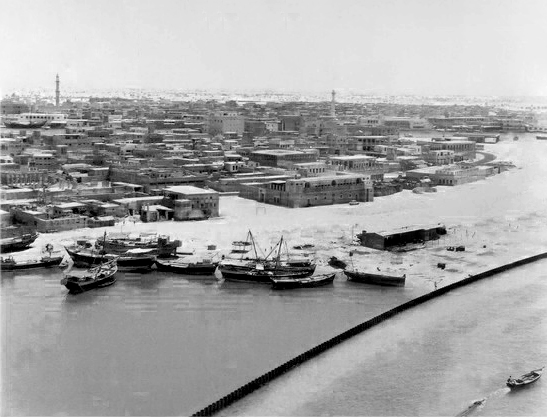
The Al Ras district in Deira, Dubai in the 1960s
Dubai came under the protection of the United Kingdom by the "Exclusive Agreement" of 1892, in which the UK agreed to protect Dubai against the Ottoman Empire. Two catastrophes struck the town during the 1800s. First, in 1841, a smallpox epidemic broke out in the Bur Dubai locality, forcing residents to relocate east to Deira. Then, in 1894, fire swept through Deira, burning down most homes.[25] However, the town's geographical location continued to attract traders and merchants from around the region. The emir of Dubai was keen to attract foreign traders and lowered trade tax brackets, which lured traders away from Sharjah and Bandar Lengeh, the region's main trade hubs at the time. Persian merchants naturally looked across to the Arab shore of the Persian Gulf finally making their homes in Dubai. They continued to trade with Lingah, however, as do many of the dhows in Dubai Creek today, and they named their district Bastakiya, after the Bastak region in southern Persia.
Dubai's geographical proximity to Iran made it an important trade location. The town of Dubai was an important port of call for foreign tradesmen, chiefly those from Iran, many of whom eventually settled in the town. By the beginning of the 20th century, it was an important port. Dubai was known for its pearl exports until the 1930s; the pearl trade was damaged irreparably by World War I, and later on by the Great Depression in the 1930s. With the collapse of the pearling industry, Dubai fell into a deep depression and many residents starved or migrated to other parts of the Persian Gulf.
In the early days since its inception, Dubai was constantly at odds with Abu Dhabi. In 1947, a border dispute between Dubai and Abu Dhabi on the northern sector of their mutual border, escalated into war. Arbitration by the British and the creation of a buffer frontier running south eastwards from the coast at Ras Hasian resulted in a temporary cessation of hostilities. Electricity, telephone services, and an airport were established in Dubai in the 1950s, when the British moved their local administrative offices there from Sharjah. After years of exploration following large finds in neighboring Abu Dhabi, oil was eventually discovered in Dubai in 1966, albeit in far smaller quantities. This led the emirate to grant concessions to international oil companies, thus igniting a massive influx of foreign workers, mainly Indians and Pakistanis. Between 1968 and 1975 the city's population grew by over 300%.
On 2 December 1971 Dubai, together with Abu Dhabi and five other emirates, formed the United Arab Emirates after the former protector, Britain, left the Persian Gulf in 1971. In 1973, Dubai joined the other emirates to adopt a uniform currency: the UAE dirham. Qatar and Bahrain chose to remain independent nations. In 1973, the monetary union with Qatar was dissolved and the UAE Dirham was introduced throughout the Emirates.
During the 1970s, Dubai continued to grow from revenues generated from oil and trade, even as the city saw an influx of immigrants fleeing the Lebanese civil war. Border disputes between the emirates continued even after the formation of the UAE; it was only in 1979 that a formal compromise was reached that ended hostilities. The Jebel Ali port was established in 1979. Jafza (Jebel Ali Free Zone) was built around the port in 1985 to provide foreign companies unrestricted import of labor and export capital.

The Gulf War of 1990 had a negative financial effect on the city, as depositors withdrew their money and traders withdrew their trade, but subsequently the city recovered in a changing political climate and thrived. But later in the 1990s, many foreign trading communities—first from Kuwait, during the Gulf War, and later from Bahrain, during the Shia unrest—moved their businesses to Dubai.Dubai provided refueling bases to allied forces at the Jebel Ali Free Zone during the Gulf War, and again during the 2003 Invasion of Iraq. Large increases in oil prices after the Gulf War encouraged Dubai to continue to focus on free trade and tourism.

Dubai History

LIVE LONG DUBAI

Dubai

Dubai

Dubai is a city in the United Arab Emirates (UAE), located within the emirate of the same name. The emirate of Dubai is located south east of the Persian Gulf on the Arabian Peninsula and is one of the seven emirates in the country. It has the largest population in the UAE and the second-largest land territory by area of all the emirates, after Abu Dhabi. Dubai and Abu Dhabi are the only two emirates to have veto power over critical matters of national importance in the country's legislature. The city of Dubai is located on the emirate's northern coastline. Dubai is often misperceived as a country and in some cases, the whole UAE has been described as 'Dubai'.

The earliest mention of Dubai is in 1095 AD, and the earliest settlement in the region dates from 1799. Dubai was formally established in 1833 by Sheikh Maktoum bin Buti al Maktoum when he persuaded 800 members of the Bani Yas tribe, living in what is now part of Saudi Arabia, to follow him to the Dubai Creek by the Al Abu Falasa clan of Bani Yas. It remained under clan control when the United Kingdom assumed the protection of Dubai in 1892. Its strategic geographical location made it an important trading hub and by the beginning of the 20th century, it was an important port.

Today, Dubai has emerged as a cosmopolitan metropolis that has grown to become a global city and a business and cultural hub of the Middle East. Although Dubai's economy was built on the oil industry, the emirate's model of business drives its economy, with the effect that its main revenues are now from tourism, real estate, and financial services, similar to that of Western countries. Dubai has recently attracted world attention through many innovative large construction projects and sports events. The city has become symbolic for its skyscrapers and high-rise buildings, such as the Burj Khalifa which is the tallest structure in the world, in addition to developments projects including man-made islands, hotels and some of the largest shopping malls in the region. This increased attention has also highlighted labour rights and human rights issues concerning its largely South Asian workforce. Dubai's property market experienced a major deterioration in 2008 and 2009 as a result of the worldwide economic downturn following the financial crisis of 2007–2012. However, Dubai made a steady and gradual recovery. As of 2012, Dubai is the 22nd most expensive city in the world, surpassing London (25th) and is the most expensive city in the Middle East, surpassing Tel Aviv (31st). Mercer rated Dubai as the best place to live in the Middle East.