stone tools have been found at many sites, little is known about the UAE's early inhabitants as only a few settlements have been found. Many ancient towns in the area were trading centers between the Eastern and Western worlds. The remnants of an ancient mangrove swamp, dated at 7,000 BC, were discovered during the construction of sewer lines near Dubai Internet City. The area was covered with sand about 5,000 years ago as the coast retreated inland, becoming a part of the city's present coastline. Pre Islamic ceramics have been found from the 3rd and 4th century. Prior to Islam, the people in this region worshiped Bajir (or Bajar). The Byzantine (Greek) and Sassanian (Persian) empires constituted the great powers of the period, with the Sassanians controlling much of the region. After the spread of Islam in the area, the Umayyad Caliph, of the eastern Islamic world, invaded south-east Arabia and drove out the Sassanians. Excavations by the Dubai Museum in the region of Al-Jumayra (Jumeirah) found several artifacts from the Umayyad period.

Alras Deira Mid
Al Fahidi Fort, built in 1799, is the oldest existing building in Dubai – now part of the Dubai Museum
The earliest recorded mention of Dubai is in 1095, in the "Book of Geography" by the Andalusian-Arab geographer Abu Abdullah al-Bakri. The Venetian pearl merchant Gaspero Balbi visited the area in 1580 and mentioned Dubai (Dibei) for its pearling industry. Since 1799, there has been a settlement known as Dubai town. In the early 19th century, the Al Abu Falasa clan (House of Al-Falasi) of Bani Yas clan established Dubai, which remained a dependent of Abu Dhabi until 1833. On 8 January 1820, the sheikh of Dubai and other sheikhs in the region signed the "General Maritime Peace Treaty" with the British government. In 1833, following tribal feuding, the Al Maktoum dynasty (also descendants of the House of Al-Falasi) of the Bani Yas tribe left their ancestral home of the Liwa Oasis, South-west of the settlement of Abu Dhabi and quickly took over Dubai from the Abu Fasala clan without resistance.
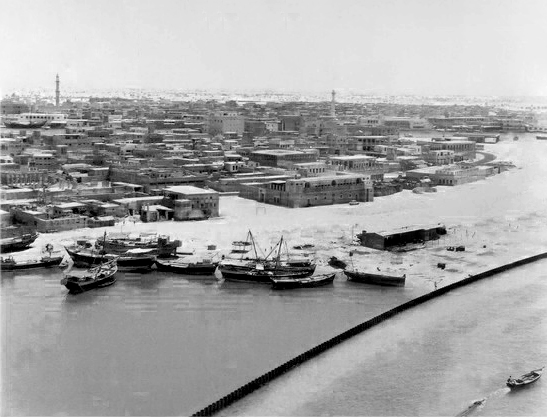
The Al Ras district in Deira, Dubai in the 1960s
Dubai came under the protection of the United Kingdom by the "Exclusive Agreement" of 1892, in which the UK agreed to protect Dubai against the Ottoman Empire. Two catastrophes struck the town during the 1800s. First, in 1841, a smallpox epidemic broke out in the Bur Dubai locality, forcing residents to relocate east to Deira. Then, in 1894, fire swept through Deira, burning down most homes.[25] However, the town's geographical location continued to attract traders and merchants from around the region. The emir of Dubai was keen to attract foreign traders and lowered trade tax brackets, which lured traders away from Sharjah and Bandar Lengeh, the region's main trade hubs at the time. Persian merchants naturally looked across to the Arab shore of the Persian Gulf finally making their homes in Dubai. They continued to trade with Lingah, however, as do many of the dhows in Dubai Creek today, and they named their district Bastakiya, after the Bastak region in southern Persia.
Dubai's geographical proximity to Iran made it an important trade location. The town of Dubai was an important port of call for foreign tradesmen, chiefly those from Iran, many of whom eventually settled in the town. By the beginning of the 20th century, it was an important port. Dubai was known for its pearl exports until the 1930s; the pearl trade was damaged irreparably by World War I, and later on by the Great Depression in the 1930s. With the collapse of the pearling industry, Dubai fell into a deep depression and many residents starved or migrated to other parts of the Persian Gulf.
In the early days since its inception, Dubai was constantly at odds with Abu Dhabi. In 1947, a border dispute between Dubai and Abu Dhabi on the northern sector of their mutual border, escalated into war. Arbitration by the British and the creation of a buffer frontier running south eastwards from the coast at Ras Hasian resulted in a temporary cessation of hostilities. Electricity, telephone services, and an airport were established in Dubai in the 1950s, when the British moved their local administrative offices there from Sharjah. After years of exploration following large finds in neighboring Abu Dhabi, oil was eventually discovered in Dubai in 1966, albeit in far smaller quantities. This led the emirate to grant concessions to international oil companies, thus igniting a massive influx of foreign workers, mainly Indians and Pakistanis. Between 1968 and 1975 the city's population grew by over 300%.
On 2 December 1971 Dubai, together with Abu Dhabi and five other emirates, formed the United Arab Emirates after the former protector, Britain, left the Persian Gulf in 1971. In 1973, Dubai joined the other emirates to adopt a uniform currency: the UAE dirham. Qatar and Bahrain chose to remain independent nations. In 1973, the monetary union with Qatar was dissolved and the UAE Dirham was introduced throughout the Emirates.
During the 1970s, Dubai continued to grow from revenues generated from oil and trade, even as the city saw an influx of immigrants fleeing the Lebanese civil war. Border disputes between the emirates continued even after the formation of the UAE; it was only in 1979 that a formal compromise was reached that ended hostilities. The Jebel Ali port was established in 1979. Jafza (Jebel Ali Free Zone) was built around the port in 1985 to provide foreign companies unrestricted import of labor and export capital.

The Gulf War of 1990 had a negative financial effect on the city, as depositors withdrew their money and traders withdrew their trade, but subsequently the city recovered in a changing political climate and thrived. But later in the 1990s, many foreign trading communities—first from Kuwait, during the Gulf War, and later from Bahrain, during the Shia unrest—moved their businesses to Dubai.Dubai provided refueling bases to allied forces at the Jebel Ali Free Zone during the Gulf War, and again during the 2003 Invasion of Iraq. Large increases in oil prices after the Gulf War encouraged Dubai to continue to focus on free trade and tourism.