Showing posts with label hamdan. Show all posts

Monday, 26 November 2012

DUBAI MALL


The Dubai Mall is the world's largest shopping mall based on total area and sixth largest by gross leasable area. Located in Dubai, United Arab Emirates, it is part of the 20-billion-dollar Burj Khalifa complex, and includes 1,200 shops.Access to the mall is provided via Doha Street, rebuilt as a double-decker road in April 2009.
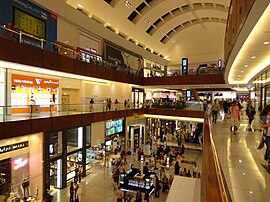


Twice delayed, Dubai Mall opened on 4 November 2008, with about 635 retailers, marking the world's largest-ever mall opening in retail history. However it is not the largest in gross leasable space, and is surpassed in that category by several malls including the South China Mall, which is the world's largest, Golden Resources Mall, SM City North Edsa, and SM Mall of Asia.
The Dubai Mall recorded 60,000 tickets sold for the Dubai Aquarium and Discovery Centre in the first five days, following its opening.The Dubai Mall hosted over 37 million visitors in 2009, and attracts more than 750,000 visitors every week. while in 2010 it hosted 47 million, and saw footfall increase by around 27 percent over 2009, despite the economic crisis.In 2011, Dubai Mall became the world's most-visited shopping and leisure destination, and attracted more than 54 million visitors, the traffic was a 15 per cent increase from 2010 and surpassed 50.2 million visitors to New York City. The numbers also surpass visitor arrivals to all landmark leisure destinations and theme parks in the world including Times Square (39.2 million), Central Park (38 million), and Niagara Falls (22.5 million).


Description

Outside Dubai Mall near the Fountain.
Over 12 million sq ft (equivalent in size to more than 50 football pitches), the Dubai Mall has a total internal floor area of 5.9 million square feet (55 ha) and leasable space of 3.77 million square feet (35 ha), about the same as the West Edmonton Mall.
It also has a 250-room luxury hotel, 22 cinema screens plus 120 restaurants and cafes. The Mall has over 14,000 parking spaces across 3 car parks, with valet services and a car locator ticketing system. The mall has won five awards - two awards at the Retail Future Project Awards at Mapic, Cannes, in 2004, for Best Retail Development Scheme (Large) and Best Use of Lighting in a Retail Environment] and the Dubai Mall brochure collected three awards at the Summit Creative Awards 2005 in Portland, Oregon - the Gold award for Best Art Direction / Graphic Design, Silver award for Best 4-colour B2B Brochure, and a Judges Special Recognition award.


Dubai Aquarium and Under Water Zoo

The shark tunnel of Dubai Aquarium & Underwater Zoo
The Mall's Dubai Aquarium and Discovery Centre, developed and operated by Oceanis Australia Group, officially earned the Guinness World Record for the world's "Largest Acrylic Panel" (32.88 m wide × 8.3 m high × 750 mm thick and weighing 245,614 kg). The acrylic viewing panel is larger than Japan's Okinawa Churaumi Aquarium (22.5 m wide × 8.2 m high and 600 mm thick). Its 750 mm thick acrylic viewing panel can withstand pressure of 10 million litres of water used in the aquarium, but its transparency gives visitors clear views of over 33,000 marine animals on display.[6] In February 2010, a leak in the aquarium caused a partial evacuation and brief shutdown of a portion of the mall.
The Mall adopted an International Standard of Ethics and Animal Welfare Policy in its development and operation.

Dubai Ice Rink

Ice Rink inside Dubai Mall.
The Mall's Dubai Ice Rink multi-purpose venue, uses refrigeration plant technology by developing 1.5 inches (38 mm) of ice bed, 2 times the thickness of an NHL ice rink for Olympic-sized attraction. Dubai Ice Rink can host a capacity of up to 2,000 guests, when converted into a multi-functional hall with world-class multimedia system including a 20 m × 10 m LED screen. Operations Manager, Richard Rowlands, a 7 years Welsh figure skating pairs champion, described it: "Dubai Ice Rink in itself is an exciting facility, bringing the first-ever Olympic-sized ice rink to Dubai. A top-class facility offering the best of, including over 1,800 pairs of skates imported from a leading manufacturer in Italy to fit children and adults of all ages and sizes, the Dubai Ice Rink will host themed nights, Learn-to-Skate programs, figure skating lessons and hockey matches.The advanced technology used at the Dubai Ice Rink ensures that the consistency of the ice-bed is maintained at all times. By incorporating the refrigerator technology of pushing in glycol through a network of pipes, and monitoring the cooling over a period of five to six days, the 38 mm ice-bed is tailored to withstand multiple activities in a safe environment."

SEGA Republic

SEGA Republic, a 76,000 sq ft (7,100 m2) indoor theme park, was opened on 21 August 2009. Visitors can enjoy over 150 amusement games; The Redemption Zone hosts one of the region's largest selection of redemption games as well as a huge selection of winnable merchandise for all ages. It is a park that is mainly dedicated to SEGA's icon Sonic the Hedgehog. The entrance to Sega Republic is located on the second floor of The Dubai Mall.

Reel Cinemas

Main article: Reel Cinemas
The Reel Cinemas opened on 14 August 2009 on the second floor of Dubai Mall. Reel Cinema is a 22 screen megaplex with more than 2,800 seats. All screens are currently open. It is the largest cinema in the region.[19] More than 10,000 visitors visited the cineplex in its opening week.[20] It is operated by Reel Entertainment LLC, a joint venture formed by Emaar Retail LLC and Singapore-based entertainment provider Cathay Organisation Holdings Ltd to develop cinemas across the Middle East. The flagship 22-screen Reel Cinemas at The Dubai Mall is the first megaplex developed and operated by the venture, and will soon be followed by the 6-screen Reel Cinemas at Dubai Marina Mall. The Reel Cinemas is located on the 2nd level of the mall. Of the 22 screens present, there are both 2D and 3D screens available. A new movie starts at the Reel Cinemas every 10 minutes. 

Shops

The Dubai Mall contains more than 1,200 shops and is anchored by Galeries Lafayette, Debenhams, Bloomingdale's, Waitrose and Marks & Spencer.
In October 2009 it was reported that the world's largest candy store opened in Dubai Mall.

Construction

The mall was built by a joint venture of Dutco Balfour Beatty, Al Ghandi/CCC and Turner Construction[citation needed] for Emaar Properties and was scheduled to be completed in 2006, claiming to be the size of 50 "international-sized football (soccer) pitches". Most of the workers used in construction of the mall were Indian, Pakistani, Bangladeshi and Sri Lankan guest workers. The internal mobile phone coverage for Dubai Mall was commissioned, integrated and carried out by Motorola Dubai for Etisalat and du. Multimedia and acoustic design is by Shen Milsom & Wilke, London . Gulf precast was incharge of the precast job on the outside.


World records and achievements

Dubai Mall near the Fountain at Dusk.
Largest mall in the world with total area 1,124,000m2.
Worlds sixth largest mall with Gross Leasable Area (GLA) 350,000m2.
World’s largest acrylic panel (Aquarium) inside Dubai Mall, which is (32.88 m wide × 8.3 m high × 750 mm thick and weighing 245 tons).
World’s largest sweet shop "Candylicious" spanning over 10,000 sq ft (930 m2) inside Dubai Mall.
Dubai Mall records more than 5 million visitors in the month of March,2010 during the one-month Dubai Shopping Festival, setting an all-time record in visitor footfall
Dubai Mall has been named the best shopping experience on 29 April 2010 by Grazia Style Awards.
The Dubai Mall hosted a record 37 million visitors in its first year of operation in 2009, and attracts more than 750,000 visitors every week.
The Dubai Mall hosted a record 47 million visitors in 2010, and broke the record of 37 million visitors received last year, an increase of 27 percent despite the economic crisis.
The Dubai Mall hosted a record 54 million visitors in 2011, and broke the record of 47 million visitors received last year, an increase of 15 percent.
In 2011, Dubai Mall becomes the world's most-visited shopping and leisure destination, and attracted more than 54 million visitors thus surpassed 50.2 million visitors to New York City, the visitor numbers also surpass visitor arrivals to all landmark leisure destinations and theme parks in the world including Times Square, 39.2 million, Central Park 38 million, and Niagara Falls 22.5 million.


Sunday, 25 November 2012

DUBAI METRO

DUBAI METRO


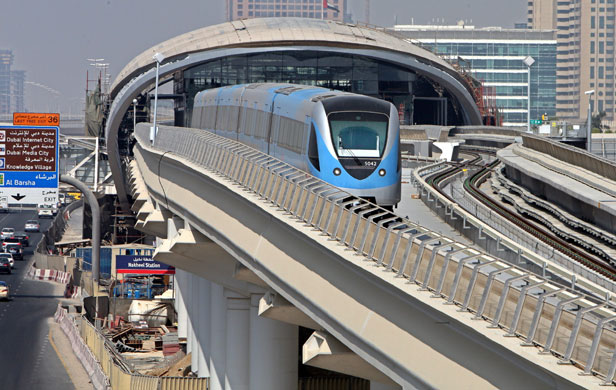
The Dubai Metro is a driverless, fully automated metro rail network in the United Arab Emirates city of Dubai. The Red Line and Green Line are operational, with three further lines planned. These first two lines run underground in the city centre and on elevated viaducts elsewhere (elevated railway). All trains and stations are air conditioned with platform edge doors to make this possible.

The first section of the Red Line, covering 10 stations, was ceremonially inaugurated at 9:09:09 PM on 9 September 2009, by Mohammed bin Rashid Al Maktoum, Ruler of Dubai, with the line opening to the public at 6 AM on 10 September.The Dubai Metro is the first urban train network in the Arabian Peninsula. More than 110,000 people, which is nearly 10 per cent of Dubai’s population, used the Metro in its first two days of operation. The Dubai Metro carried 10 million passengers from launch on 9 September 2009 to 9 February 2010 with 11 stations operational on the Red Line.
Guinness World Records has declared Dubai Metro as the world's longest fully automated metro network spanning at 75 kilometres (47 mi).

DUBAI METRO


OPERATION


The Dubai Metro is operated by Serco under contract to the Dubai Roads & Transport Authority.
Before launch, Dubai Municipality Public Transport Department expected the metro to carry 1.2 million passengers on an average day, 27,000 passengers per hour for each line, and 355 million passengers per year once both lines are fully operational. It is planned provide transport for 12% of all trips in Dubai. After the first month of operation (on a limited network), the actual monthly ridership was 1,740,578, which equates to under 60,000 passengers/day.[20] After the opening of more stations in May 2010, ridership surged to 103,002 passengers/day and reached 130,000/day by the beginning of October 2010, though still short of the originally anticipated 140,000 passengers/day,[21] ridership is expected to rise to 170,000/day by the end of 2010. When the Green Line opened on 9 September 2011, ridership on the Red Line was noted as 180,000/day, with the new line expected to add as much as 120,000/day to the network.
One issue for the new system will be how to reliably and comfortably get riders to their final destination if it is not located at a metro station. The RTA has changed and added "feeder bus routes" which act as shuttle services to and from major locations in and around the station area. There are bus and taxi laybys constructed as well as drop off zones at each station for ease of passenger access.
In addition 268 km of light rail lines are also planned, these will serve as feeders to the Dubai Metro. The Al Sufouh Tramway is one of the light rail plans.

 LINES


The first two lines of the Dubai Metro will have 70 kilometres (43 mi) of lines, and 47 stations (including nine underground stations).
The Roads and Transport Authority's masterplan includes 320 km of metro lines up to 2020 to cater to the expected 3.3 million population of the city. There are plans for 268 km of light rail tracks to act as a feeder system for the Metro. The fate of this entire network – which would reportedly be divided into Yellow, Orange, Magenta and Black lines – is now dependent on an economic recovery and private investment.

LIST OF STATIONS

Dubai Metro is composed of at-grade (G) elevated Type 1, Type 2 and Type 3 (T1, T2 and T3, respectively) underground stations (U) and underground transfer station types (UT). Type 1 is the regular at-grade concourse station, Type 2 is a regular elevated concourse station, and Type 3 is an elevated special track station with an extra track to hold a non operational train. Underground transfer stations will be accommodating both the Red and Green lines for easy transfers.


Besides these differences, there are four themes used in the interiors of the stations: earth, water, fire and air. Earth stations have a tan-brown colour effects; water has blue-white colour effects; fire has orange-red colour effects; and the air has green colour effects.
Red Line:
Rashidiya Station (Depot)
Emirates Airlines Station
Airport Terminal 3 Station – For all Emirates Flights
Airport Terminal 1 Station – For all Non-Emirates Flights
Al Garhoud Station (GGICO station)
Deira City Centre Station
Al Rigga Station
Union Station (Interchange, connecting with Green Line)
Khalid bin Al Waleed Station (Interchange, connecting with Green Line)
Al Karama Station
Al Jafiliya Station
World Trade Centre Station
Emirates Towers Station
Financial Centre Station
Burj Khalifa / Dubai Mall Station
Business Bay Station
Noor Islamic Bank Station (Al Quoz)
First Gulf Bank Station
Mall of the Emirates Station
Sharaf DG Station
Dubai Internet City Station
Nakheel Station
Dubai Marina Station
Jumeirah Lakes Towers Free Zone Station
Nakheel Harbor and Towers Station
Ibn Battuta Station
Energy Station
Jebel Ali Industrial Station
Jebel Ali / Jafza Station
The main depot for the trains will be at Rashidiya just before the Rashidiya Station, while an auxiliary depot is located at Jebel Ali Port.
Green Line:[37]
Etisalat Station (T3)
Al Qusais 1 Station (T2)
Dubai Airport Free Zone Station (T2)
Al Nahda Station (T2)
Stadium Station (T2)
Al Quiadah Station (T2)
Abu Hail Station (T2)
Abu Baker Al Siddique Station (T2)
Salah Al Din Station (U)
Union Station (UT, connecting to Red Line)
Baniyas Square Station (U)
Palm Deira Station (U)
Al Ras Station (U)
Al Ghubaiba Station (U)
Saeediya Station (U)
Khalid Bin Al Waleed Station (UT, connecting to Red Line)
Oud Metha Station (T2)
Health Care City Station (T2)
Al Jedaf 1 Station (T2)
Creek Station (T2)
The train depot is located at Al Qusais just before the Al Qusais 2 Station.

World Tallest Tower Burj Khalifa

Burj Khalifa


BURJ KHALIFA'S GRAND VISION

World's tallest building. A living wonder. Stunning work of art. Incomparable feat of engineering. Burj Khalifa is all that. In concept and execution, Burj Khalifa has no peer.
More than just the world's tallest building, Burj Khalifa is an unprecedented example of international cooperation, symbolic beacon of progress, and an emblem of the new, dynamic and prosperous Middle East.
It is also tangible proof of Dubai's growing role in a changing world. In fewer than 30 years, this city has transformed itself from a regional centre to a global one. This success was not based on oil reserves, but on reserves of human talent, ingenuity and initiative. Burj Khalifa embodies that vision.
Mr Mohamed Alabbar, Chairman, Emaar Properties, said: "Burj Khalifa goes beyond its imposing physical specifications. In Burj Khalifa, we see the triumph of Dubai's vision of attaining the seemingly impossible and setting new benchmarks. It is a source of inspiration for every one of us in Emaar. The project is a declaration of the emirate's capabilities and of the resolve of its leaders and people to work hand in hand on truly awe-inspiring projects.  
Emaar had but one inspiration, the unflagging enthusiasm set in motion by His Highness Sheikh Mohammed Bin Rashid Al Maktoum, Vice President and Prime Minister of the UAE and Ruler of Dubai, who inspires us to reach for the stars.
Bringing Burj Khalifa to life required a combination of visionary ideals and solid science. In the process, the project amassed an awe-inspiring number of facts, figures, and statistics.
World Records

At over 828 metres (2,716.5 feet) and more than 160 stories, Burj Khalifa holds the following records:
•  Tallest building in the world
•  Tallest free-standing structure in the world
•  Highest number of stories in the world
•  Highest occupied floor in the world
•  Highest outdoor observation deck in the world
•  Elevator with the longest travel distance in the world
•  Tallest service elevator in the world 
Tallest of the Supertall

Not only is Burj Khalifa the world’s tallest building, it has also broken two other impressive records: tallest structure, previously held by the KVLY-TV mast in Blanchard, North Dakota, and tallest free-standing structure, previously held by Toronto’s CN Tower. The Chicago-based Council on Tall Buildings and Urban Habitat (CTBUH) has established 3 criteria to determine what makes a tall building tall. Burj Khalifa wins by far in all three categories.  

Height to architectural top

Height is measured from the level of the lowest, significant, open-air, pedestrian entrance to the architectural top of the building. This includes spires, but does not include antennae, signage, flagpoles or other functional-technical equipment. This measurement is the most widely used and is used to define the Council on Tall Buildings and Urban Habitat rankings of the Tallest Buildings in the World.
             
Highest occupied floor

Height is measured from the level of the lowest, significant, open-air, pedestrian entrance to the highest continually occupied floor within the building. Maintenance areas are not included.
           
Height to tip

Height is measured from the level of the lowest, significant, open-air, pedestrian entrance to the highest point of the building, irrespective of material or function of the highest element. This includes antennae, flagpoles, signage and other functional-technical equipment.

'AT THE TOP' - BURJ KHALIFA'S OBSERVATION DECK

The high point of any Khalifa experience is the view from At The Top, Burj Khalifa's observation deck. Located on level 124 of the world's tallest tower, this observatory is destined to be the highlight of any visit to the Middle East.
The journey begins in the lower ground level of The Dubai Mall. Throughout the journey to the top, visitors are entertained by a multi-media presentation of the exotic history of Dubai and the marvel of Burj Khalifa.
Take home a lasting memento of your At The Top experience. Shop at either of two At The Top boutiques: on Level 124 for ticket holders, or the publicly accessible boutique on the lower ground level of The Dubai Mall.


OPENING CEREMONY VIDEO 


Economy Of Dubai


Economy Of Dubai


Dubai's gross domestic product as of 2008 was US $82.11 billion. Although Dubai's economy was built on the back of the oil industry, revenues from oil and natural gas currently account for less than 7% of the emirate's revenues. It is estimated that Dubai produces 50,000 to 70,000 barrels (11,000 m3) of oil a day and substantial quantities of gas from offshore fields. The emirate's share in UAE's gas revenues is about 2%. Dubai's oil reserves have diminished significantly and are expected to be exhausted in 20 years. Real estate and construction (22.6%),[11] trade (16%), entrepĂ´t (15%) and financial services (11%) are the largest contributors to Dubai's economy. Dubai's top exporting destinations include India (US$ 5.8 billion), Switzerland (US$ 2.37 billion) and Saudi Arabia (US$ 0.57 billion). Dubai's top re-exporting destinations include India (US$ 6.53 billion), Iran (US$ 5.8 billion) and Iraq (US$ 2.8 billion). The emirate's top import sources are India (US$ 12.55 billion), China (US$ 11.52 billion) and the United States (US$ 7.57 billion). As of 2009 India was Dubai's largest trade partner.

Historically, Dubai and its twin across the Dubai creek, Deira (independent of Dubai City at that time), were important ports of call for Western manufacturers. Most of the new city's banking and financial centres were headquartered in the port area. Dubai maintained its importance as a trade route through the 1970s and 1980s. Dubai has a free trade in gold and, until the 1990s, was the hub of a "brisk smuggling trade" of gold ingots to India, where gold import was restricted. Dubai's Jebel Ali port, constructed in the 1970s, has the largest man-made harbour in the world and was ranked seventh globally for the volume of container traffic it supports. Dubai is also a hub for service industries such as information technology and finance, with industry-specific free zones throughout the city. Dubai Internet City, combined with Dubai Media City as part of TECOM (Dubai Technology, Electronic Commerce and Media Free Zone Authority) is one such enclave whose members include IT firms such as Hewlett-Packard, EMC Corporation, Oracle Corporation, Microsoft, and IBM, and media organisations such as MBC, CNN, BBC, Reuters, Sky News and AP.
The government's decision to diversify from a trade-based, oil-reliant economy to one that is service and tourism-oriented made property more valuable, resulting in the property appreciation from 2004–2006. A longer-term assessment of Dubai's property market, however, showed depreciation; some properties lost as much as 64% of their value from 2001 to November 2008. The large scale real estate development projects have led to the construction of some of the tallest skyscrapers and largest projects in the world such as the Emirates Towers, the Burj Khalifa, the Palm Islands and the world's fourth tallest, and most expensive hotel, the Burj Al Arab. The Dubai Financial Market (DFM) was established in March 2000 as a secondary market for trading securities and bonds, both local and foreign. As of fourth quarter 2006, its trading volume stood at about 400 billion shares, worth $95 billion in total. The DFM had a market capitalisation of about $87 billion. The other Dubai-based stock exchange is NASDAQ Dubai, which is the international stock exchange in the Middle East. Its unique market enables a range of companies, including UAE and regional small and medium-sized enterprises, to trade on an exchange with an international brand name, with easy access by both regional and international investors.
Dubai's property market experienced a major downturn in 2008 and 2009 as a result of the slowing economic climate. Mohammed al-Abbar, Chief Executive Officer of Emaar told the international press in December 2008 that Emaar had credits of $70 billion and the state of Dubai additional $10 billion while holding estimated $350 billion in real estate assets. By early 2009, the situation had worsened with the global economic crisis taking a heavy toll on property values, construction and employment. This has had a major impact on property investors in the region, some of whom are unable to release funds from investments made in property developments. One such example of this is the Vue De Lac development, which was featured in a British ITV1 documentary Homes from Hell in 2010. As of February 2009 Dubai's foreign debt was estimated at approximately $80 billion, although this is a tiny fraction of the sovereign debt worldwide.
Dubai is also known as City of Gold, a major part of economy based on Gold trades in Dubai, Dubai's total gold trading volumes in H1 2011 reached 580 tonnes (average price US$1,455)
A City Mayors survey rated Dubai as 44th among the world's best financial cities in 2007, while another report by City Mayors indicated that Dubai was the world's 33rd richest city in 2009, in terms of purchasing power parity (PPP). Dubai is also an international financial centre and has been ranked 37th within the top 50 global financial cities as surveyed by the MasterCard Worldwide Centres of Commerce Index (2007), and 1st within the Middle East.


Dubai Governance and politics


Governance and politics

Dubai's government operates within the framework of a constitutional monarchy, and has been ruled by the Al Maktoum family since 1833. The current ruler, His Highness Sheikh Mohammed bin Rashid Al Maktoum, is also the Vice President and Prime Minister of the United Arab Emirates and member of the Supreme Council of the Union (SCU). Dubai appoints eight members in two-term periods to the Federal National Council (FNC) of the UAE, the supreme federal legislative body.


The Dubai Municipality (DM) was established by the then ruler of Dubai, Rashid bin Saeed Al Maktoum in 1954 for purposes of city planning, citizen services and upkeep of local facilities. DM is chaired by Hamdan bin Rashid Al Maktoum, deputy ruler of Dubai and comprises several departments such as the Roads Department, Planning and Survey Department, Environment and Public Health Department and Financial Affairs Department. In 2001, Dubai Municipality embarked on an e-Government project with the intention of providing 40 of its city services through its web portal, dubai.ae. Thirteen such services were launched by October 2001, while several other services were expected to be operational in the future. Dubai Municipality is also in charge of the city's sanitation and sewage infrastructure.